Watercolor Theory
Learn to use the colour wheel
— ❦ —
A simple introduction to the colour wheel and the essential colour relationships every watercolor artist should understand.

A simple introduction to the colour wheel and the essential colour relationships every watercolor artist should understand.
Learn the fundamentals of colour theory and discover how to use the colour wheel to mix balanced, harmonious and expressive watercolor colours.
Every colour journey begins with blue, yellow and red.
These three essential tones form the basis of colour theory and cannot be mixed from other pigments. When combined in different ratios, they create endless new shades, harmonies and atmospheric colour variations
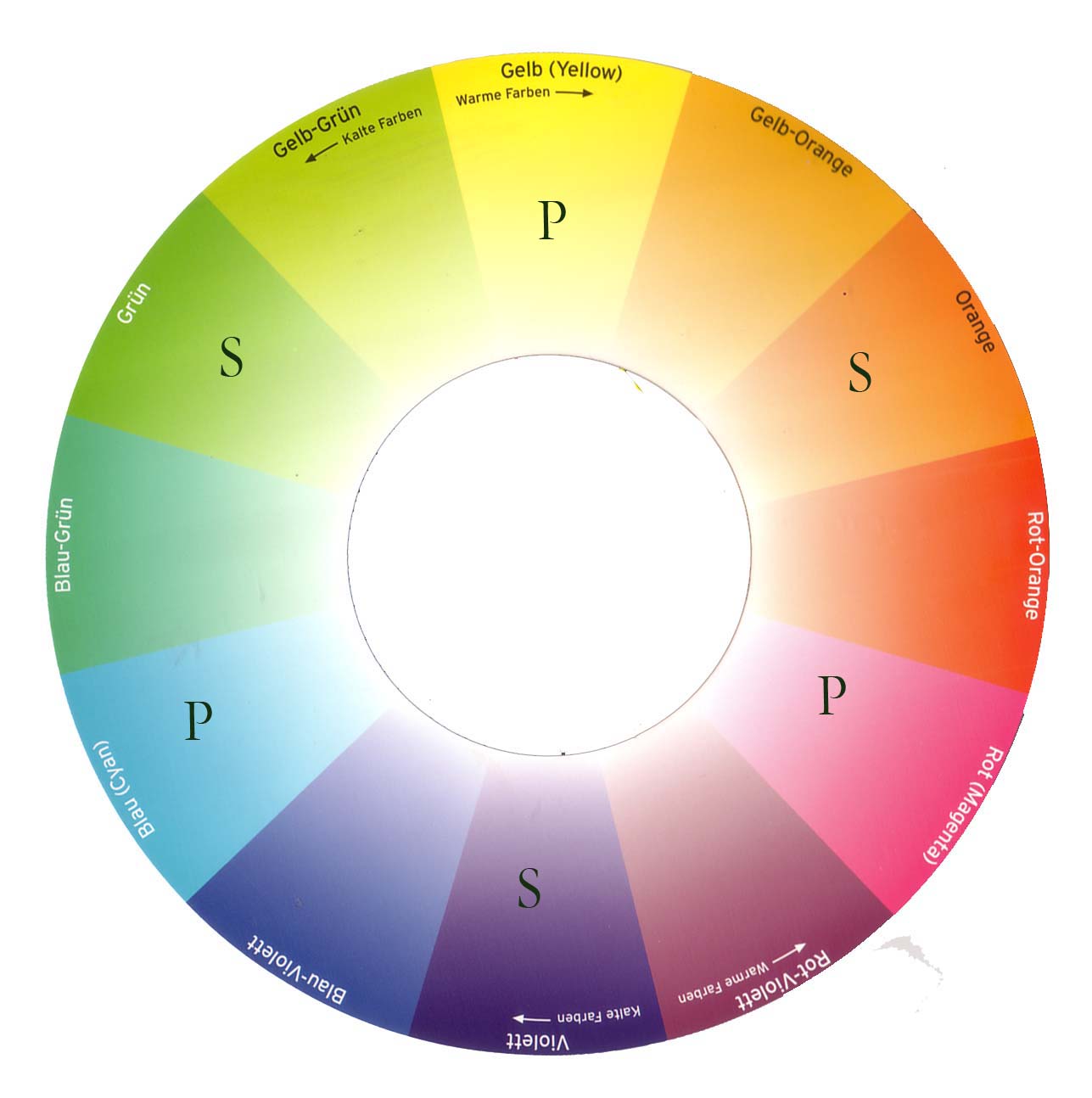
The three primary colours — blue, yellow and red — are marked with a “P”.
Notice how each primary colour is positioned at an equal distance from the others on the colour wheel.
By mixing these colours together, you can begin creating harmonious secondary colours and beautiful colour transitions.
“Colour brings harmony, atmosphere and life into every painting.”
COLOUR THEORY
Secondary colours are created by mixing two primary colours together in equal parts.
On the colour wheel, secondary colours are positioned between the primary colours they are created from.
COLOUR THEORY
Tertiary colours are created by mixing a primary colour with a neighbouring secondary colour.
They create softer transitions, subtle colour shifts and harmonious bridges between stronger colours.
COLOUR TEMPERATURE
To create clean and harmonious colour mixtures in watercolor painting,
it is helpful to work with both warm and cool variations of each primary colour.
Cool Yellow
Warm Yellow
Cool Red
Warm Red
Cool Blue
Warm Blue
Warm colours usually appear on the yellow-to-red side of the colour wheel,
while cooler colours move from yellow toward blue and green tones.
COLOUR MIXING TIP
To create clean colours, it is helpful to mix colours from the same temperature family.
When warm and cool colours are combined, the result often becomes softer, moodier and more muted.
Cool Yellow + Cool Red
bright · clear · fresh
Warm Yellow + Cool Red
soft · muted · atmospheric
“If a colour looks too muddy or muted, you may have mixed a warm and a cool colour together. Sometimes this creates beautiful atmospheric tones – but for cleaner mixtures stay within the same colour temperature family.”
PREMIUM VIDEO LESSONS & E-BOOK