Watercolor LESSON
How to Paint White Flowers in Watercolor?
— ❦ —
Discover how subtle colors, light and shadow bring a white flower to life – illustrated through the painting process of a luminous white peony.

Discover how subtle colors, light and shadow bring a white flower to life – illustrated through the painting process of a luminous white peony.
How to paint white flowers in watercolor? When you paint white flowers in watercolor, it is not really about painting with white. It is about observing the subtle colors, shadows and reflected light that give a white flower its shape and make it appear luminous.
In this tutorial, I will take you through the painting process of my white peony and share some of the things I have learned over many years about how to paint white flowers — from those first delicate shadows on untouched paper to the moment when the darker background changes everything and the flower begins to glow.
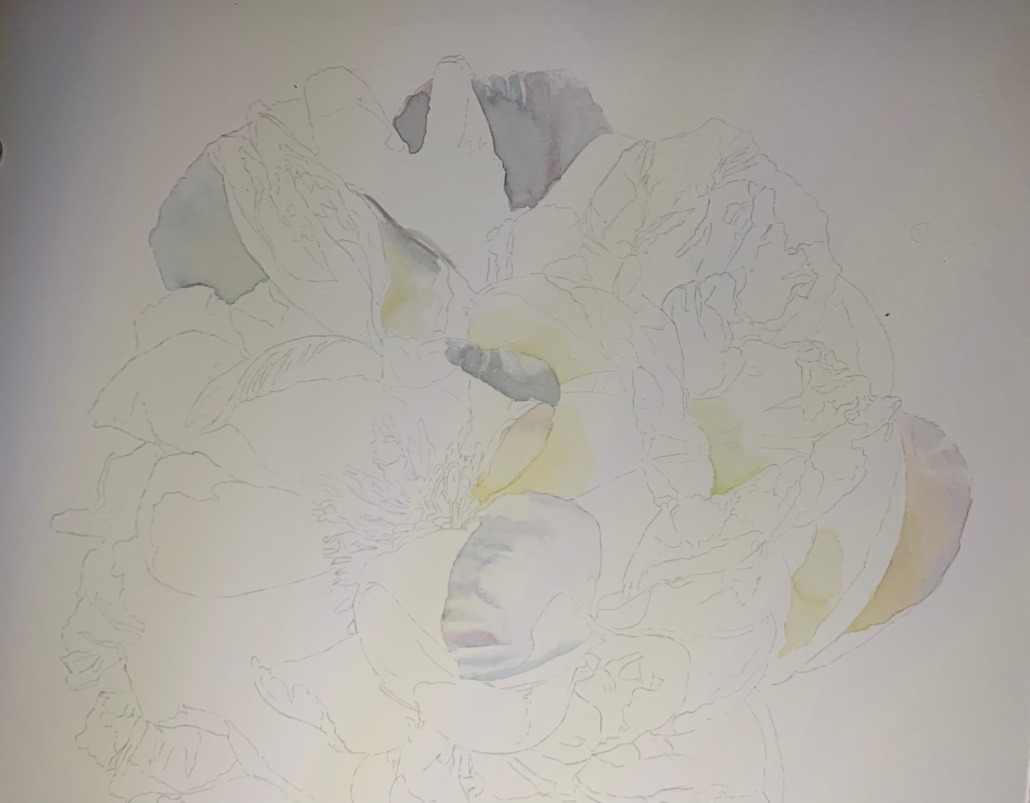
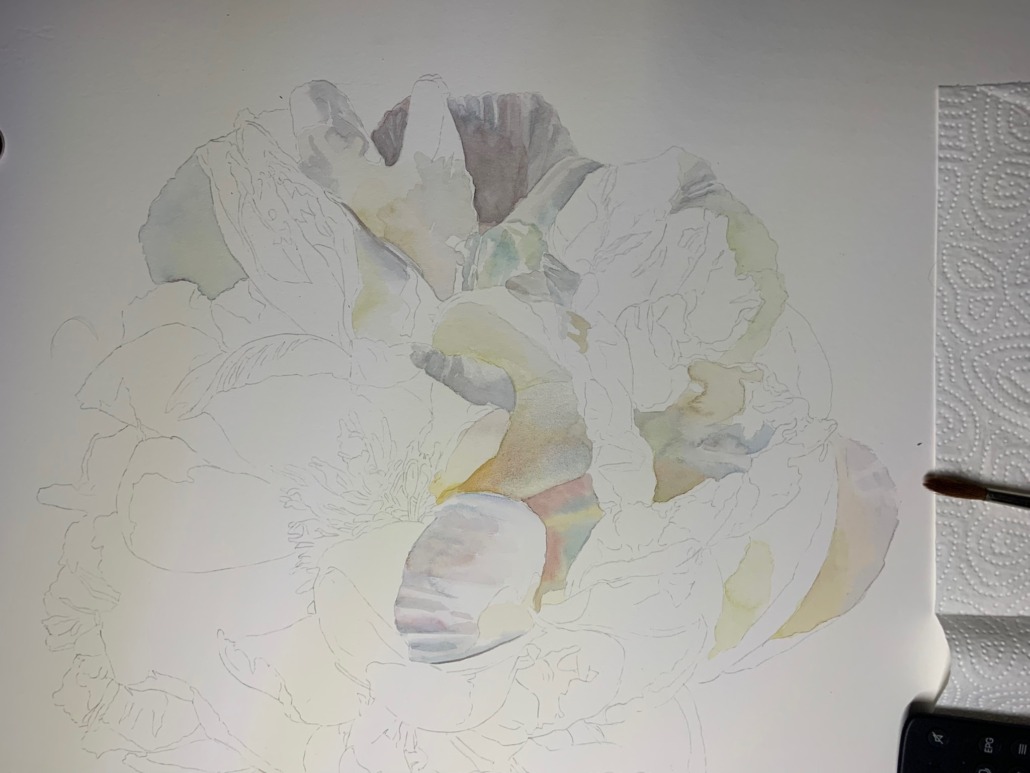
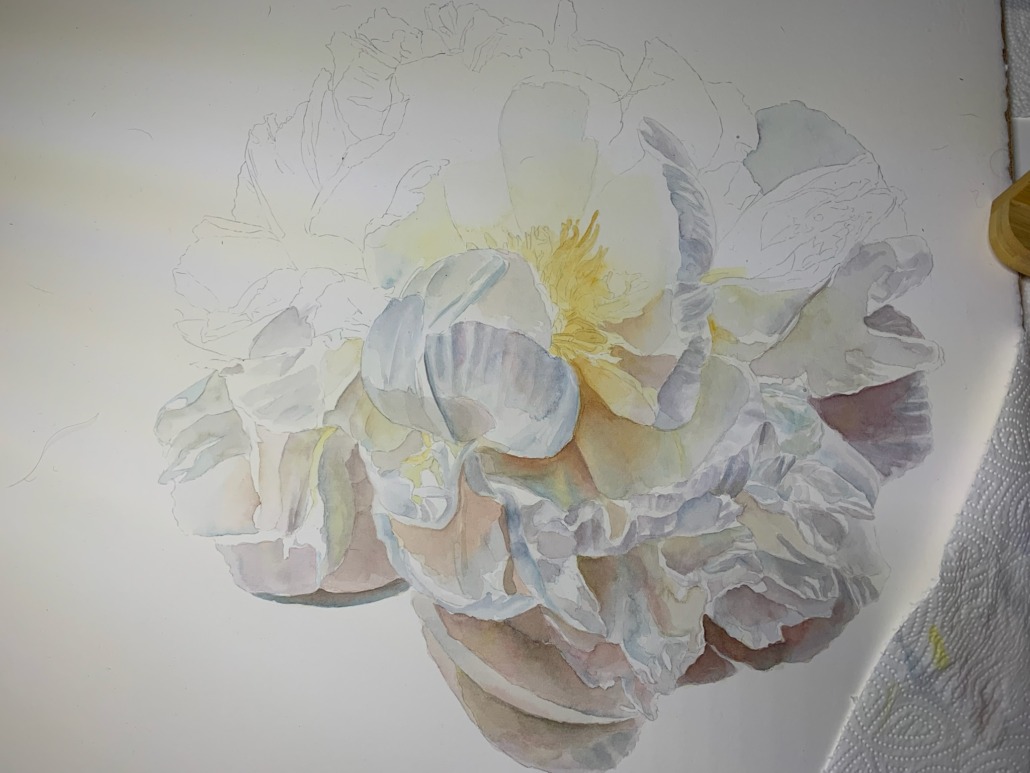
When I begin painting a white flower in watercolor, I leave the lightest areas completely untouched. The white of the watercolor paper becomes the brightest white in the finished flower.
I start by carefully observing the first subtle shadows between and beneath the petals. These shadows may contain soft blues, violets, greys or even hints of the colors surrounding the flower. At this early stage, only a few brushstrokes are needed to begin describing the form.
And this is often the moment when painting a white flower can feel surprisingly difficult: against all that untouched white paper, even a delicate shadow can suddenly look much too strong — or simply wrong.
“~ Trust the process ~
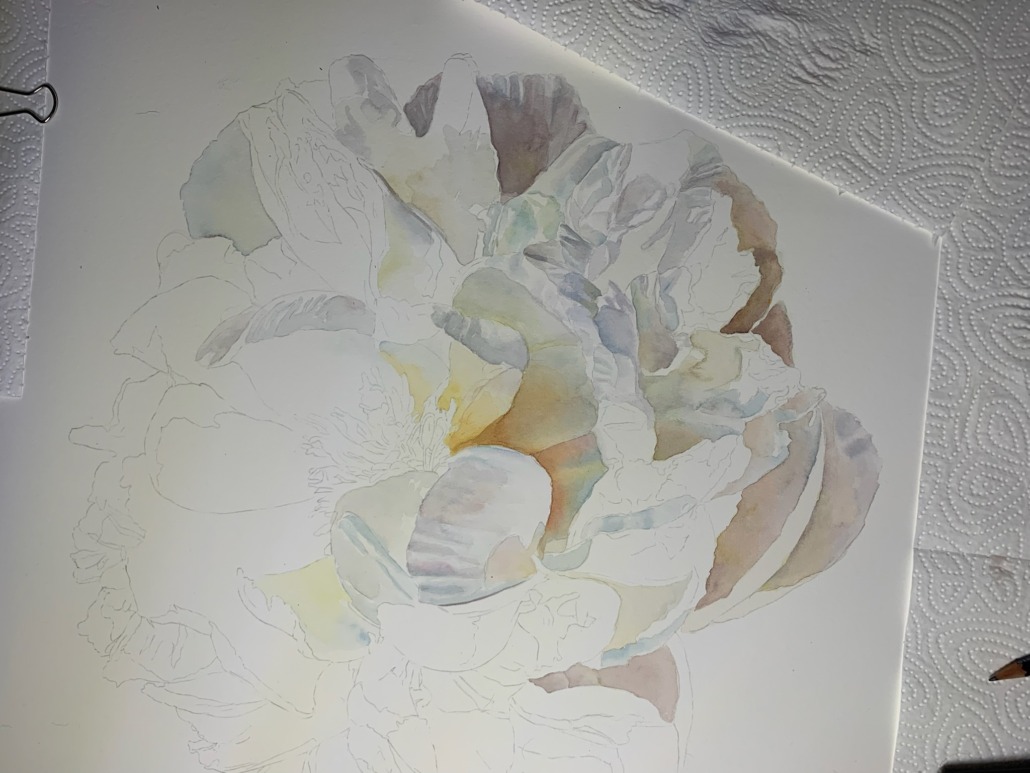
How to paint white flowers in watercolor becomes much easier when you stop thinking of the shadows as simply grey. A white flower reflects the colors around it, and its petals can contain beautiful touches of blue, violet, soft pink, warm yellow and even green.
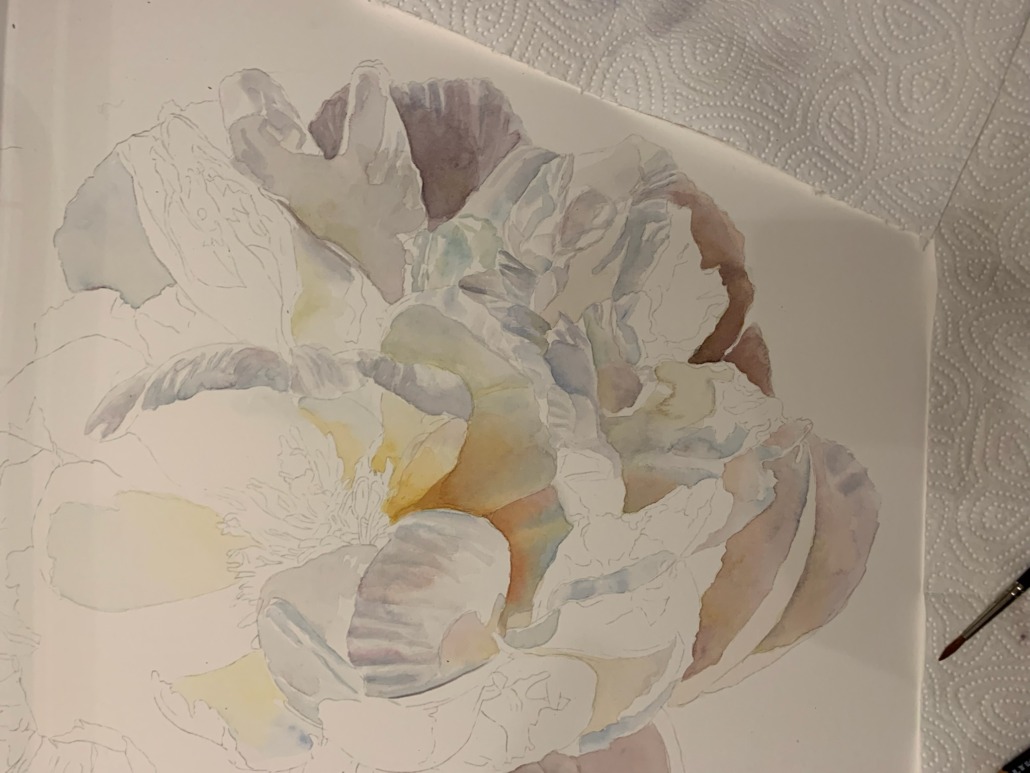
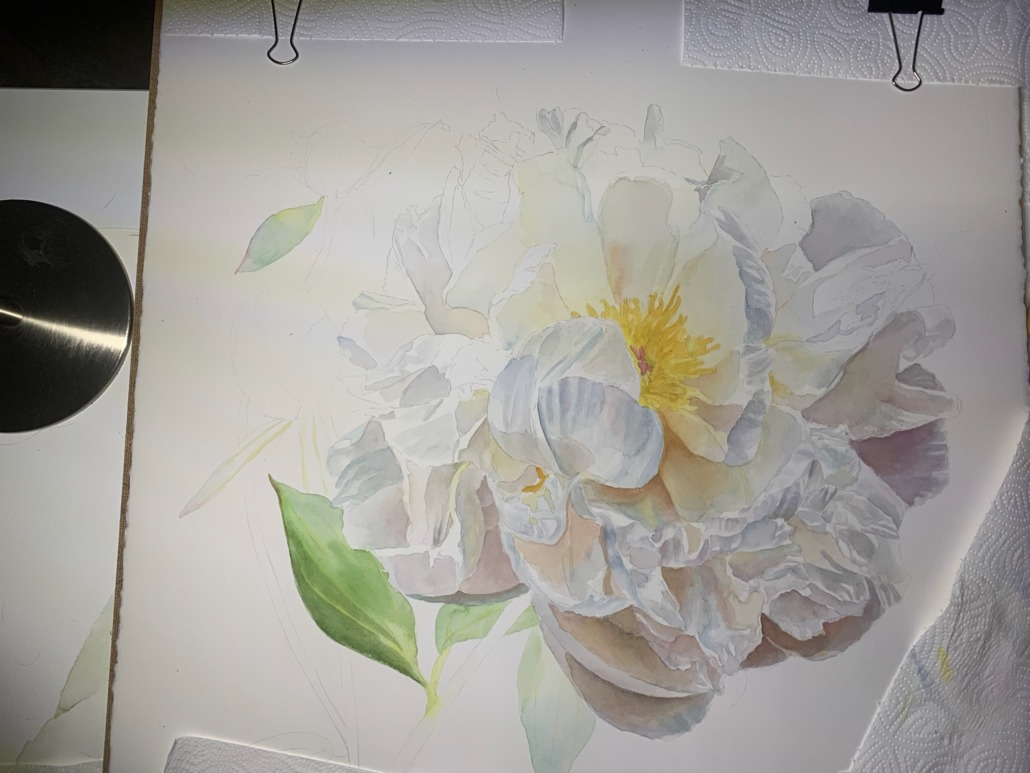
As I continue painting, I gradually deepen these colors and begin to connect the individual petals. Some shadows become stronger where one petal folds beneath another, while other edges remain soft and almost disappear. This balance between defined and lost edges gives the flower its softness and dimension.
On white watercolor paper, these colors can appear much stronger than expected. At this stage, I remind myself that I am not looking at the finished painting yet. The surrounding colors and, later, the darker background will completely change how these values are perceived.
White is not created by avoiding color.
It is created by placing color carefully around the light.
As the painting develops, I continue to build the flower slowly, layer by layer. I am not trying to paint every single petal separately. Instead, I look for the places where petals overlap, where they turn away from the light and where one shape disappears softly into another.
This is especially important when painting a white flower. If every petal is outlined or every shadow has the same strength, the flower can quickly lose its softness. Some areas need more contrast to describe the structure, while others can remain barely visible. I often allow an edge to disappear completely and let the viewer’s eye complete the shape.
The warmer colors are important too. Around the center of this peony, soft yellows and warm creamy tones influence the surrounding petals. In other areas I use cooler blues, violets and muted greys. These changes in color temperature create depth while allowing the flower to remain luminous and unmistakably white.
Notice how much color is already present although the flower still reads as white. Painting white flowers in watercolor is often a lesson in learning to see color where, at first glance, we expect to see none.
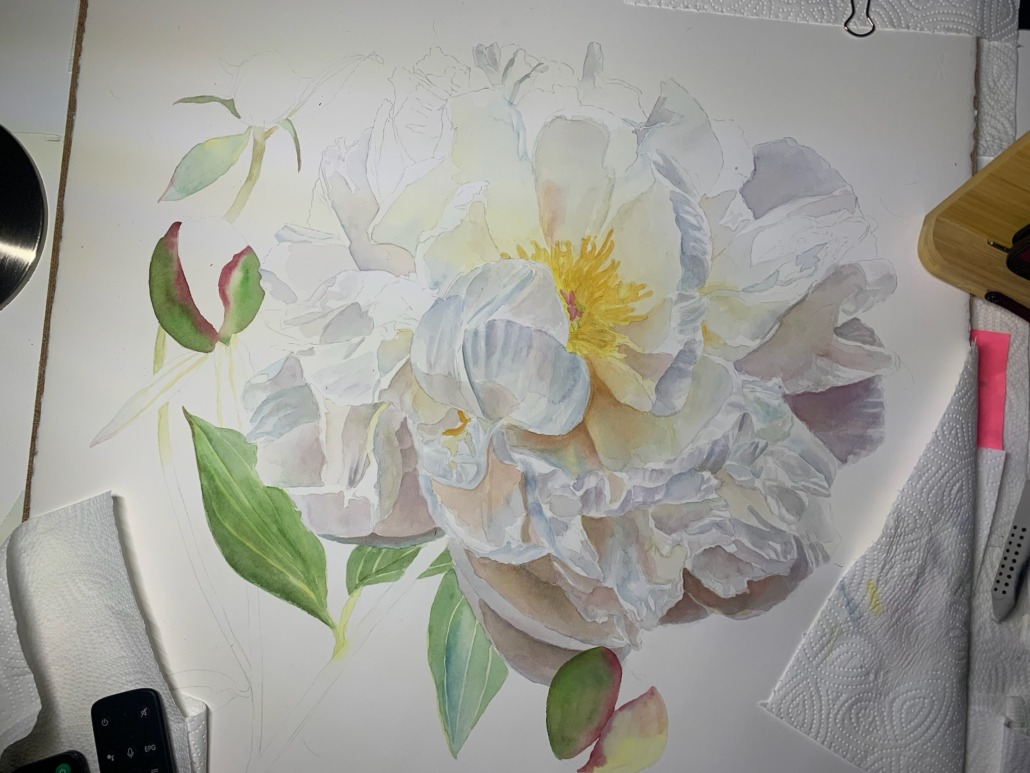
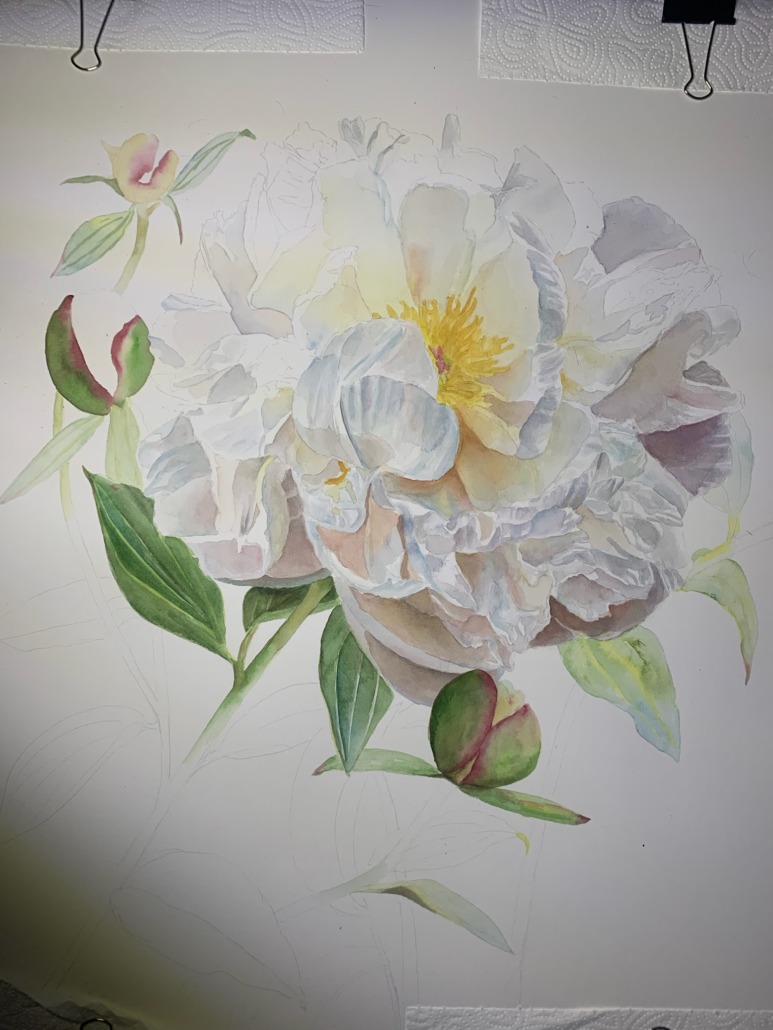
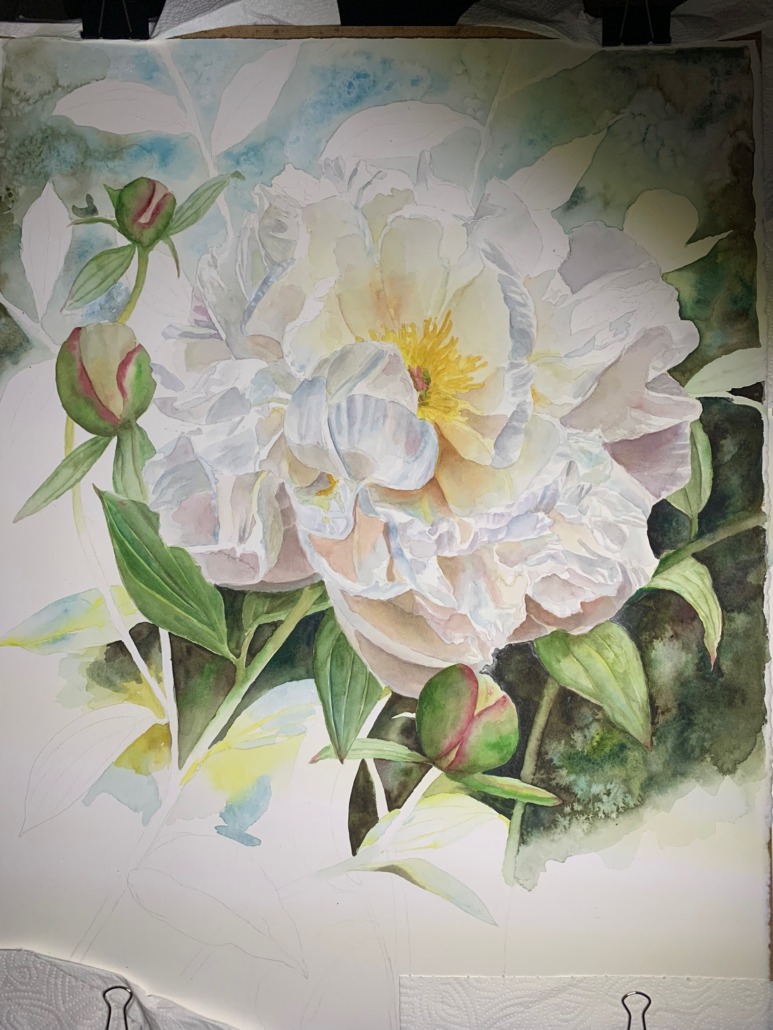
As I begin adding more leaves and buds, their greens, pinks and deeper values provide an important reference for the eye. They also begin to influence the white petals themselves. A subtle reflection of green, yellow or another surrounding color can make a white petal feel much more natural, especially in a delicate flower such as a peony.
This is why I try not to judge the values of the flower too early. A shadow that appears surprisingly dark against untouched white paper may become exactly the right value once the rest of the painting begins to develop around it.
The painting has to be allowed to grow as a whole.
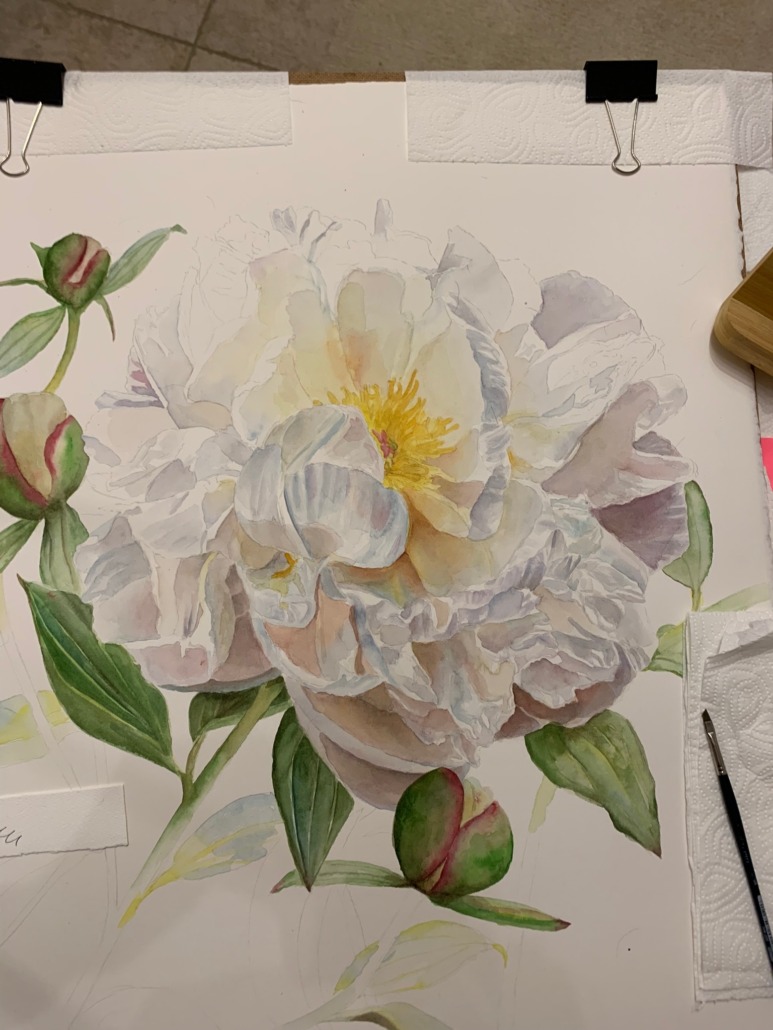
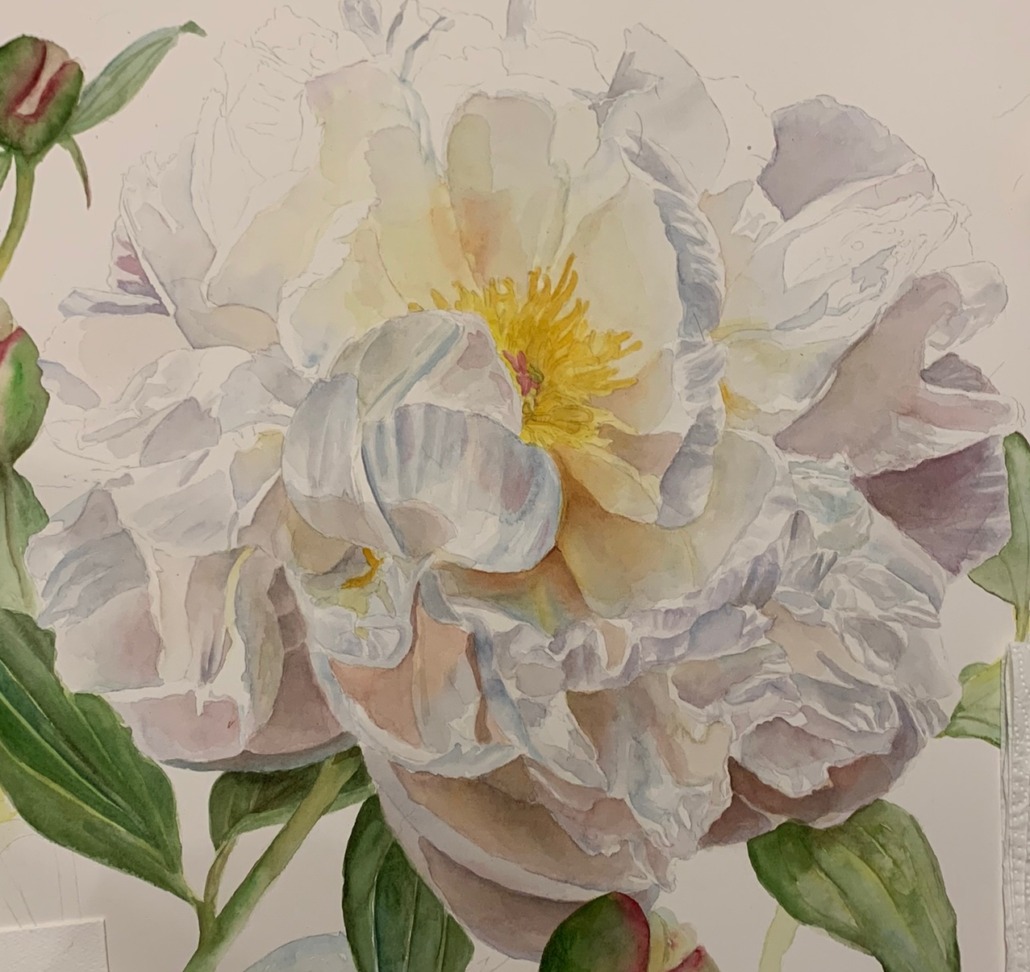
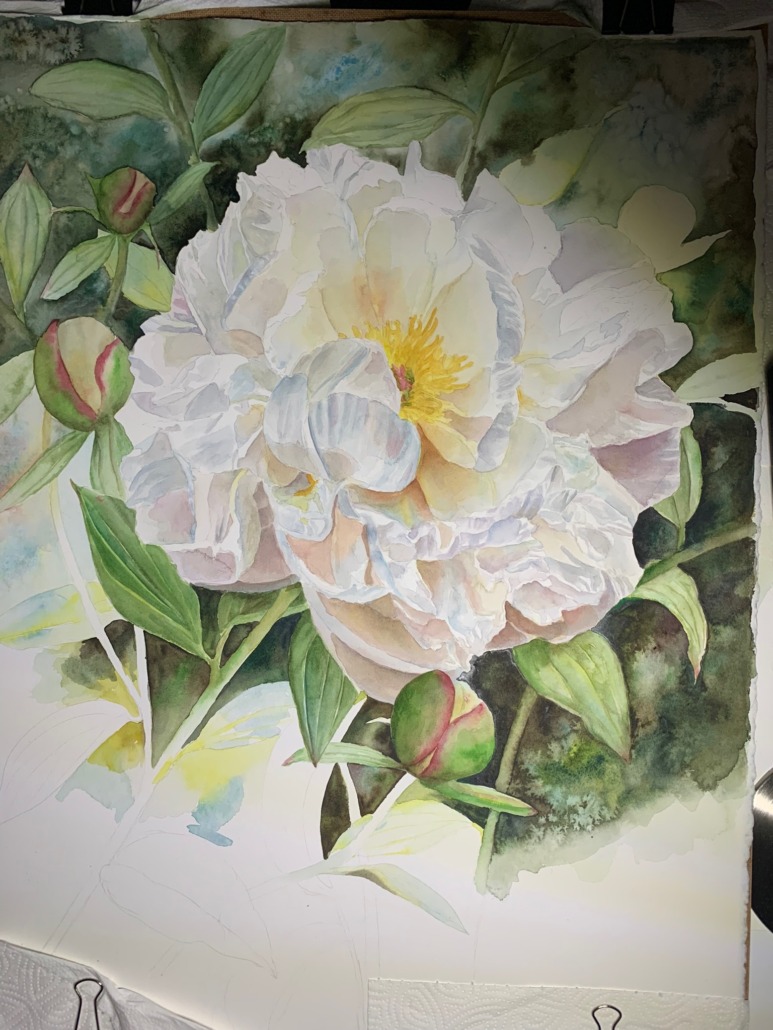
“A white flower begins to glow when the values around it become darker.”
When I begin painting a white flower, the first shadows can feel surprisingly strong. On untouched white paper, a cool blue, violet or grey mark may suddenly seem much darker than expected. Sometimes it can even feel wrong.
This is one of the reasons why I try not to judge a white flower too early. At this stage, the painting is still missing the values that will later surround it.
Once darker leaves and background colors begin to appear, the entire balance changes. The same shadows that seemed too strong before suddenly settle into place. The flower becomes more natural, the lighter areas begin to separate from one another and the untouched white of the paper starts to glow.
This change is not caused by adding more white to the flower. It happens because the values around it become deeper.
A white flower also reflects the colors of its surroundings. Greens from nearby leaves, warmer yellows from the center of the flower or cooler tones from the background can all appear very subtly in the petals. Especially in thin, delicate peony petals, these reflected colors help the flower feel connected to the rest of the painting instead of sitting separately on the page.
For me, this is one of the most fascinating parts of painting white flowers in watercolor: the flower does not become luminous in isolation. Its light is created through relationships — between warm and cool color, soft and defined edges, light and dark.
The darker the surrounding values become, the more clearly the white flower begins to reveal its light.
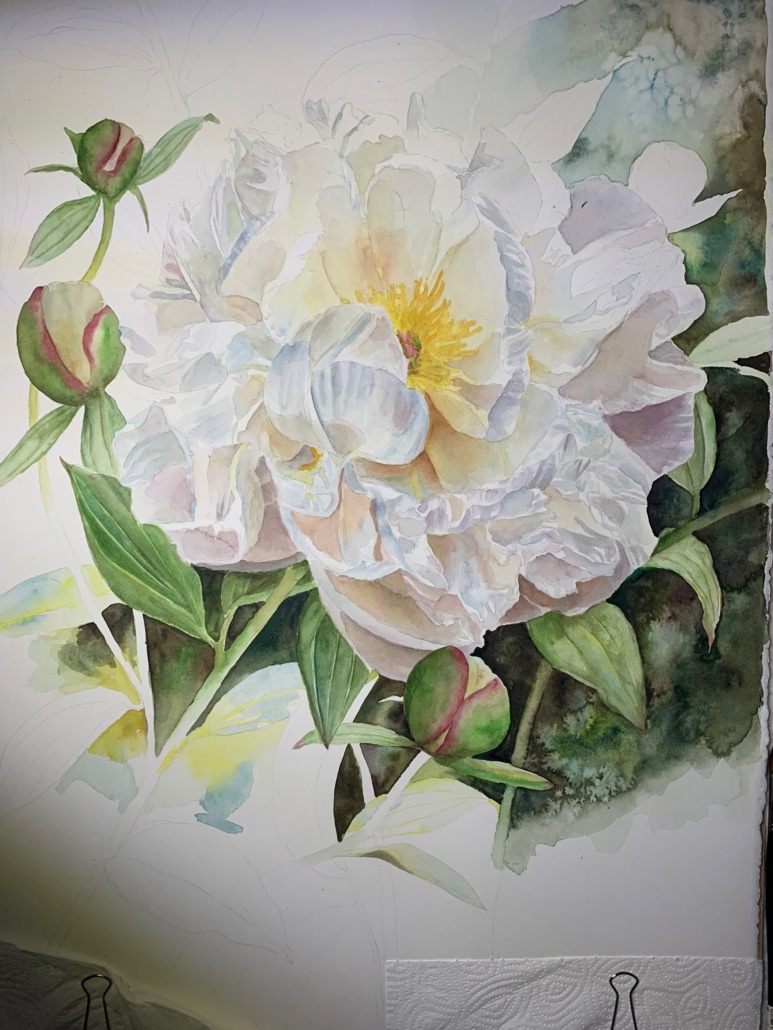
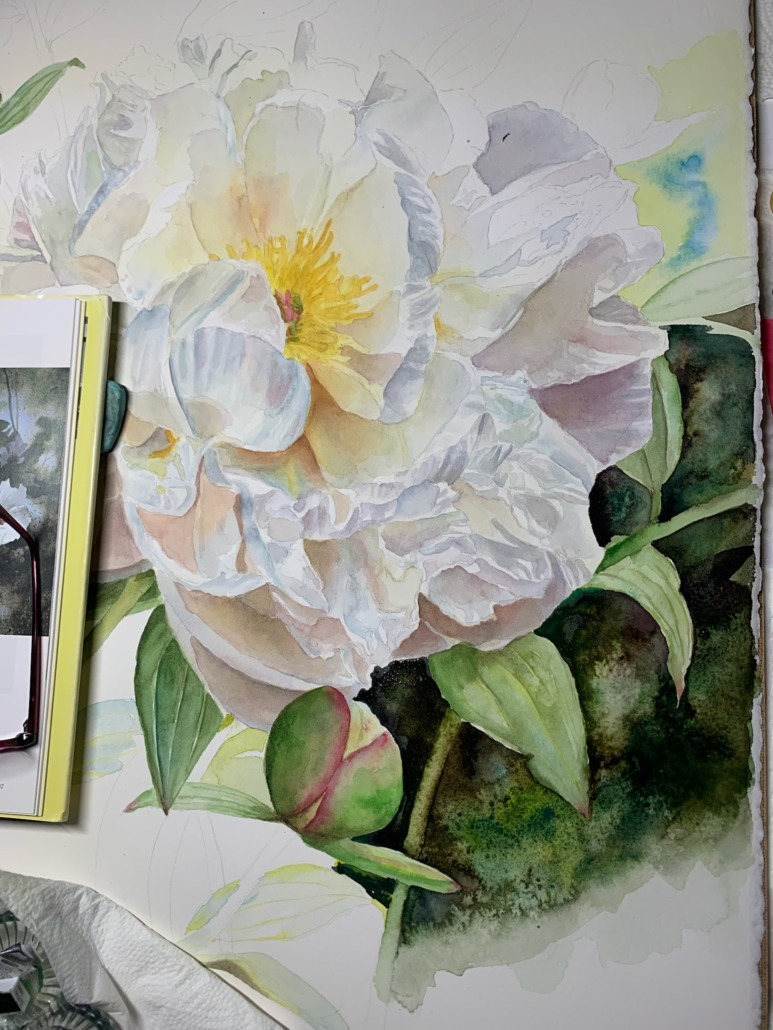
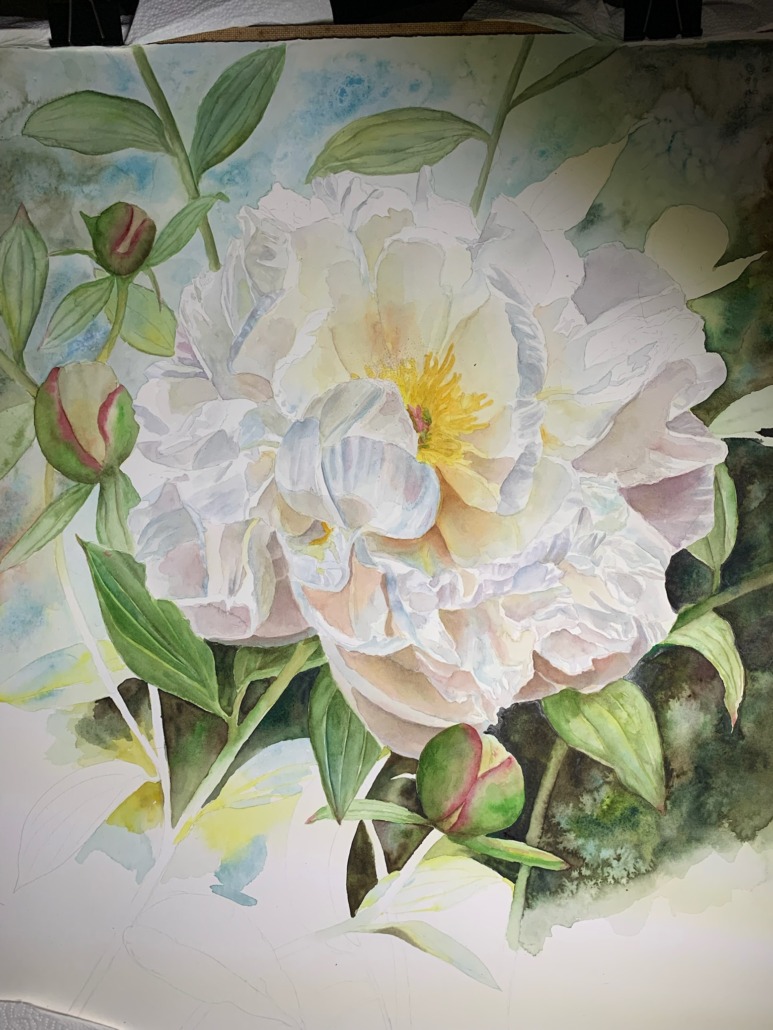
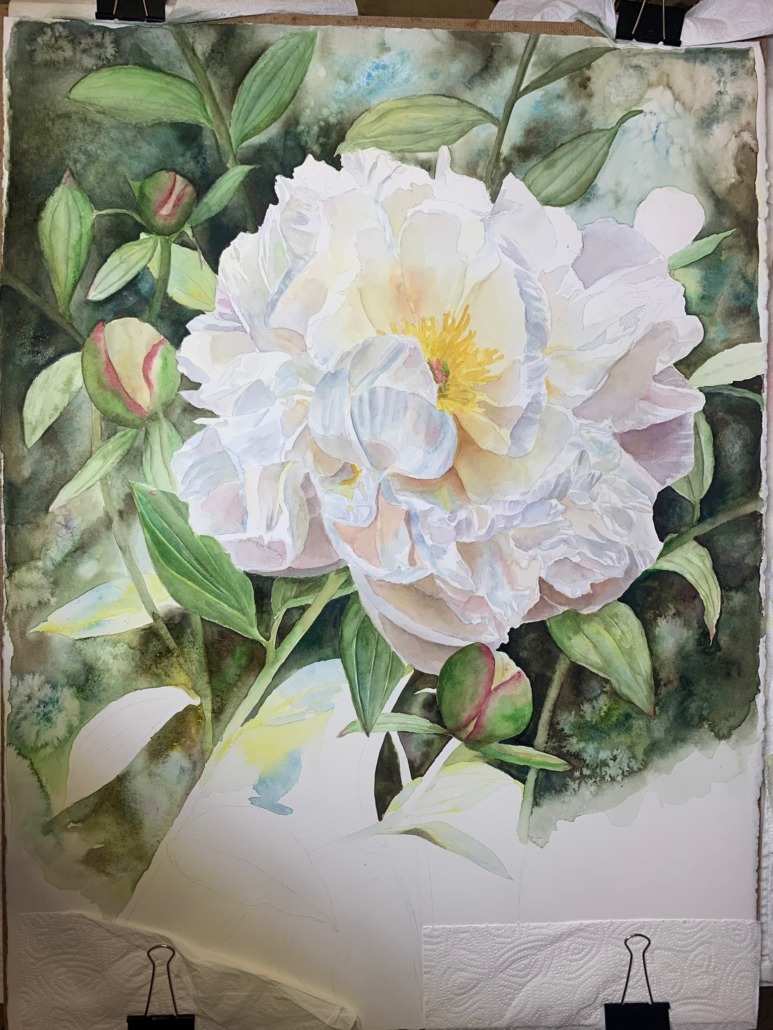
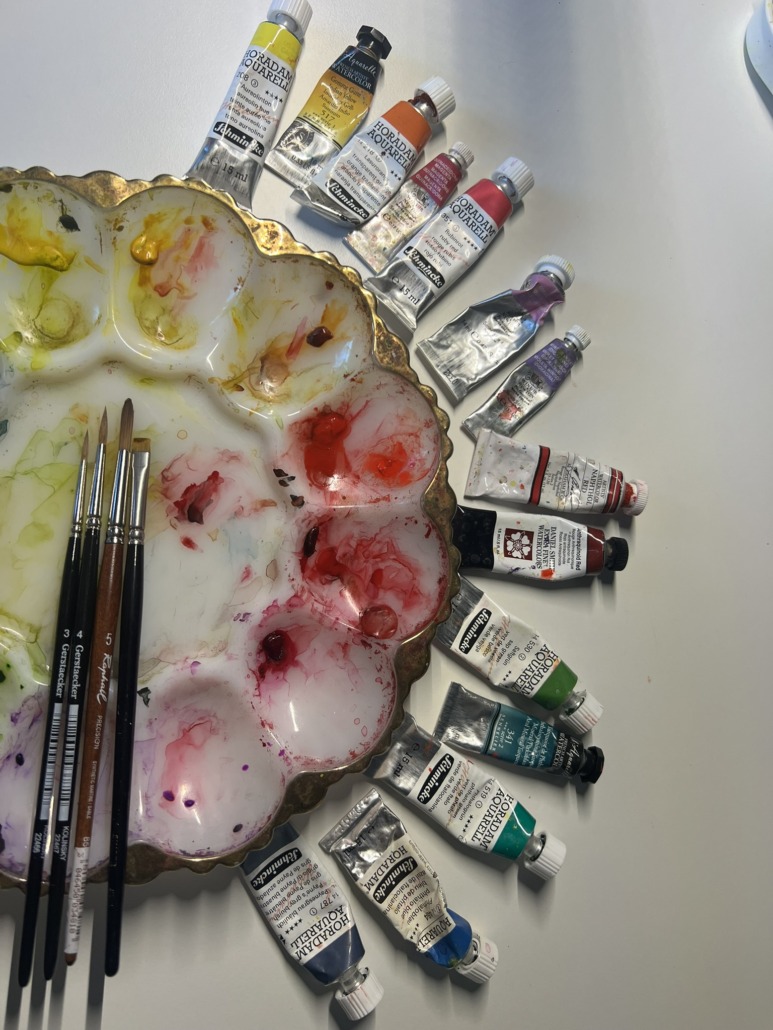
When learning how to paint white flowers in watercolor, the background becomes just as important as the flower itself. Instead of painting the white petals with more and more color, I gradually build the surrounding values and allow the untouched and lightly painted areas of the flower to emerge as the lightest parts of the painting.
For this I prefer to work mainly with transparent watercolor pigments. Their transparency allows me to build color slowly, layer upon layer, while earlier washes remain visible underneath. This creates depth and rich, luminous darks without losing the beautiful transparency that is so characteristic of watercolor.
Of course, more opaque colors can have their place too. But I use them consciously, because once an opaque layer covers the paper, the colors beneath can no longer shine through in quite the same way. For me, seeing one transparent layer through another is part of the special beauty of watercolor.
As the background grows darker, the white flower begins to appear almost by itself. Subtle shadows that seemed too strong at the beginning suddenly make sense, delicate edges become visible, and the preserved white paper begins to glow against the surrounding color.
When I build a dark watercolor background, I do not try to reach the final depth in one wash. I work gradually around the flower, leaves and buds, allowing each area to develop step by step. This gives me much more control over the values and helps me keep the background lively instead of flat.
Some passages remain softer and more transparent, while others are strengthened with additional layers. I also pay close attention to the edges around the petals. A few sharper edges help define the flower, but other edges can remain soft or partially disappear into the background. This variation is what keeps the painting natural and prevents the white peony from looking cut out.
As the darker values begin to surround the flower, the effect on the white petals becomes much more noticeable. The shadows that seemed strong at the beginning start to settle into place, and the lighter areas of the flower appear brighter without adding any white paint at all.
One of the most important things when learning how to paint white flowers is understanding that light and dark need each other. The flower does not glow because it is painted whiter. It glows because the surrounding values become deeper and give the preserved light of the paper something to contrast against.
I prefer to build this contrast slowly. By adding transparent layers, letting areas dry and returning with deeper mixtures, I can increase the depth without covering everything underneath. This keeps the background rich, varied and full of movement — and allows the white flower to remain luminous.
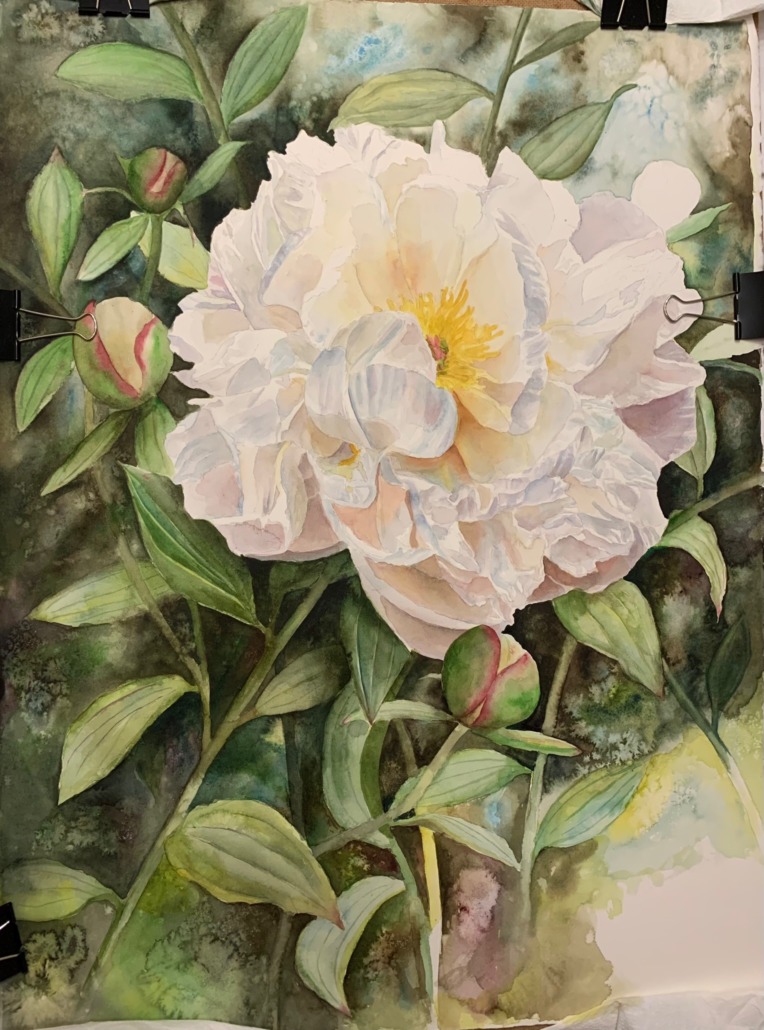
The most beautiful textures in watercolor are often the ones we cannot completely control.
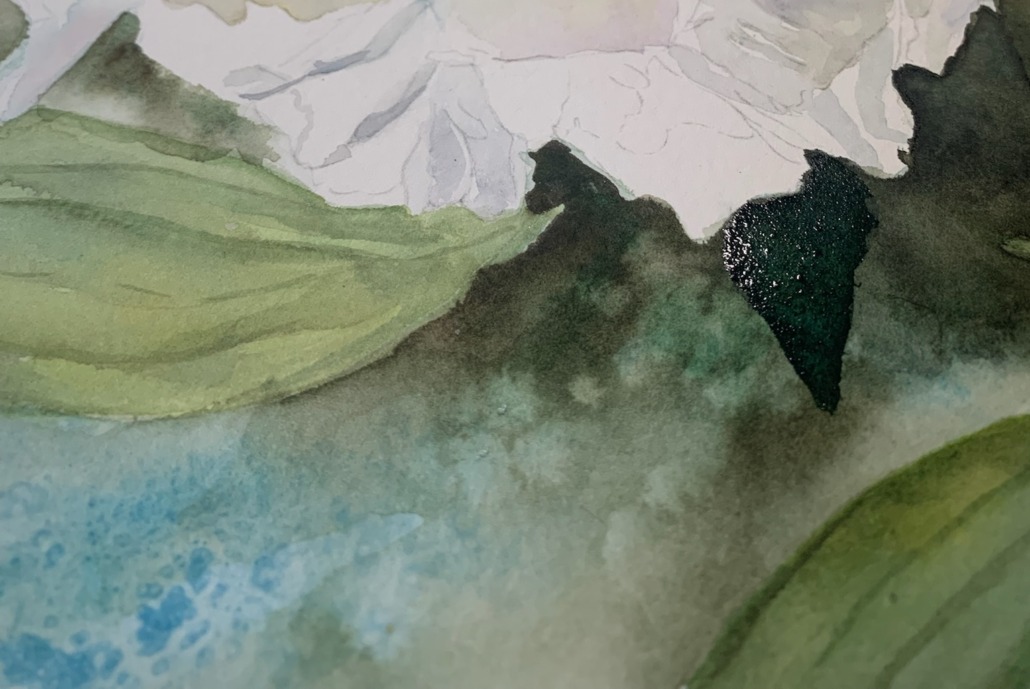
One of the techniques I sometimes use to create interesting textures in a watercolor background is salt. While the paint is still damp, I sprinkle a small amount of salt onto selected areas and simply let watercolor and salt do their work.
As the wash dries, the salt draws moisture and pigment toward itself, creating beautiful irregular patterns. The result is never completely predictable. It depends on how wet the paper is, how much pigment is present and at which moment the salt is added.
I like to use this effect selectively rather than covering the entire background. A few textured areas can bring movement and variety into the darker passages, while quieter washes nearby give the eye a place to rest. Once the area is completely dry, the salt can be gently brushed away.
In the final stages of a watercolor painting, I like to step back and look at the painting as a whole. Instead of concentrating on individual petals, I ask myself where a little more depth is needed, which edges should remain crisp and which ones can quietly disappear into the surrounding shapes.
This is also the moment when all those earlier decisions begin to come together. The delicate shadows describe the folds of the petals, the darker leaves and background create contrast, and the untouched paper provides the brightest light. When you paint white flowers in watercolor, you often discover that the most luminous areas are the ones you have painted the least.
I try not to refine every part of the painting equally. Some passages can remain soft and suggestive, while a few carefully chosen details bring the flower into focus. Knowing when to stop is part of the process too. Watercolor needs a little space to breathe.
Sometimes the final step is simply recognizing that the painting has already said enough.
If you enjoy following my watercolor process and would like to receive new tutorials, painting inspiration and little glimpses from my studio, you are warmly invited to
join my newsletter.
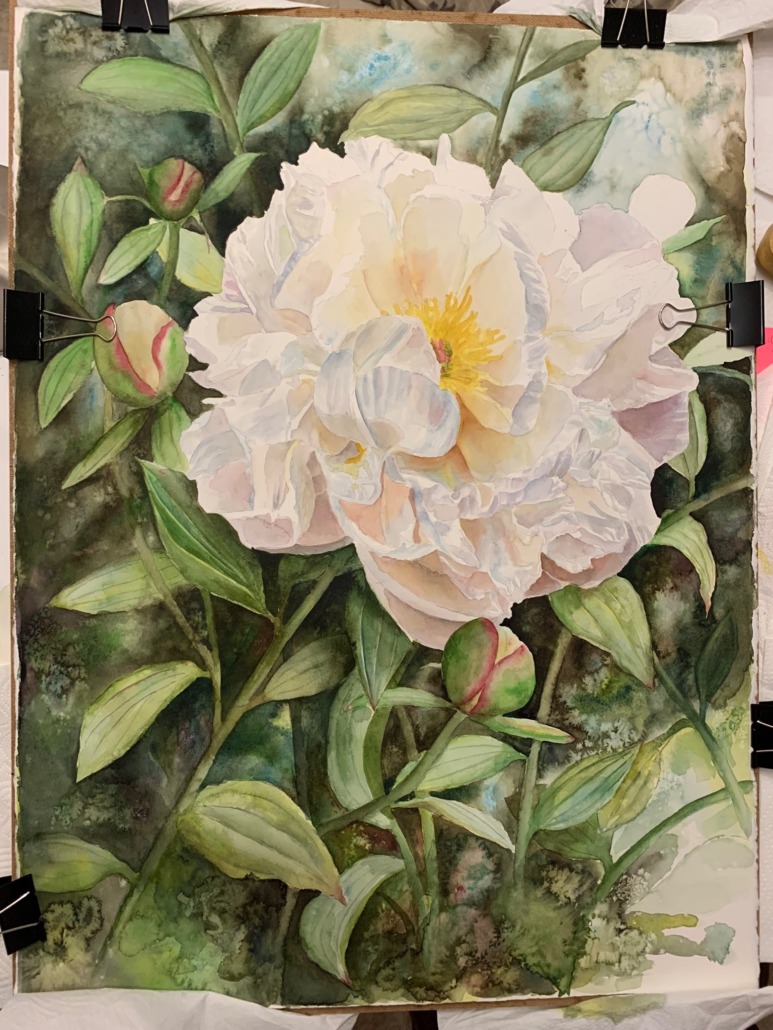
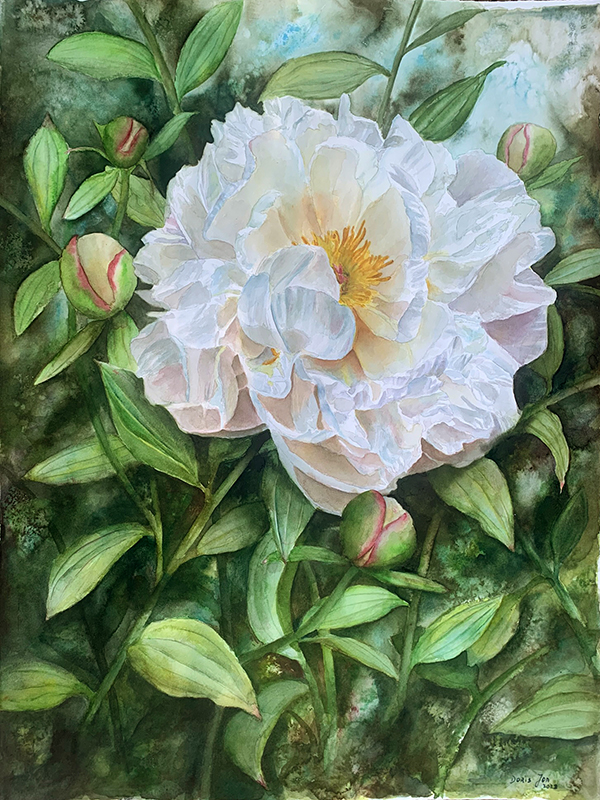
This white peony is an original watercolor painting created with the techniques shown throughout this tutorial. If you love original floral art, I invite you to discover my collection of available paintings.
Would you like to explore this painting process in much greater detail? In my White Rose Watercolor Masterclass, I guide you step by step through painting luminous white petals, delicate shadows and a rich dark background.
Learn how subtle color and strong contrast can make a white flower glow.
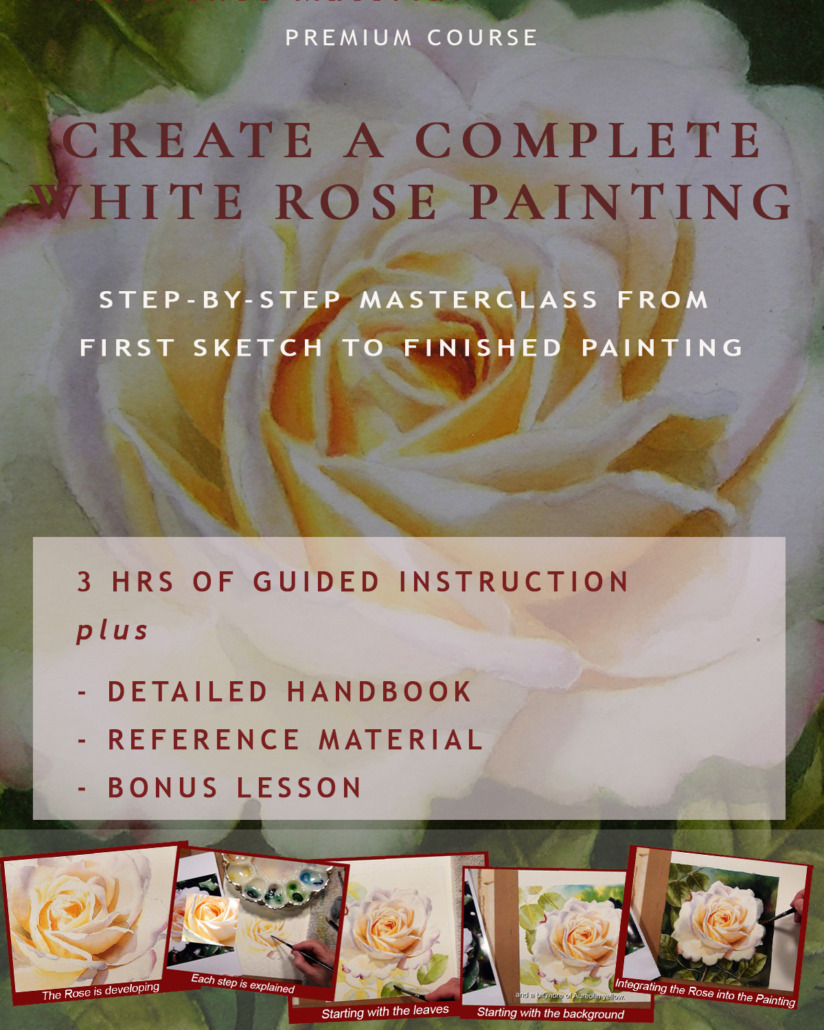
PREMIUM VIDEO LESSONS & E-BOOK