
Watercolor Materials & Artist Notes
Watercolor Paper, Aquabord or Canvas?
The surface beneath your brush changes the entire character of a watercolor. Here I share the papers and boards I have worked with, what makes each one different, and why there is no single “best” surface for every artist.
140 lb / 300 gsm
Available with smooth or textured surfaces. It is wonderfully versatile, but I stretch it before painting.
300 lb / 640 gsm
A strong, heavy paper that usually stays flat without stretching and offers a more pronounced surface.
Boards & Canvas
Alternative surfaces with very different handling—especially interesting for miniatures or paintings displayed without glass.
The watercolor papers I use
Over the years I have painted mainly on Arches, Fabriano and Lanaquarelle watercolor paper. My most frequently used surfaces are:
- 140 lb (300 gsm) cold pressed watercolor paper
- 140 lb (300 gsm) hot pressed watercolor paper
- 300 lb (640 gsm) cold pressed watercolor paper

Lighter 140 lb paper needs to be stretched before I begin. I wet the sheet, place it on a simple wooden board and staple it securely. I have also tried water-activated tape, but stapling has always been the more reliable method for me. Tape can still be added around the edges to create a clean border.
Watercolor paper can be purchased in blocks, individual sheets and large rolls. I often choose a roll of 140 lb paper when I want to create a particularly large painting.
My experience: beautiful details are possible on every paper. The important thing is learning how that particular surface responds to water, pigment and brush pressure.
Hot pressed or cold pressed?
140 lb hot pressed paper has a very smooth surface—almost like an eggshell or porcelain. It allows delicate detail and a very refined appearance, but it is also less forgiving because every brushmark remains visible.
140 lb cold pressed paper has more texture and is generally easier to handle. I can still paint very fine details on it, while the subtle texture adds life to the washes.
300 lb cold pressed paper is much heavier and usually does not need to be stretched. Its surface is more pronounced than that of 140 lb cold pressed paper. I often work on it with less water and use the texture of the dry paper to preserve small white areas and create lively marks.
Some heavyweight papers have a smoother surface that sits somewhere between traditional hot pressed and cold pressed paper. They combine the stability of heavy paper with the possibility of working in fine detail. Paintings on watercolor paper are normally framed behind glass for protection.
There is no paper that is perfect for everyone. A surface that feels difficult at first may become a favourite once you understand how it behaves.
Crescent Watercolor Board

The surface of Crescent Watercolor Board is similar to 140 lb hot pressed paper, although I find it even less forgiving. The board does not need to be stretched. It comes in large, very thick sheets and can be difficult to cut.
Its smooth surface makes it particularly suitable for miniature painting. The small portrait shown here was painted on Crescent Watercolor Board, which allowed me to work with very fine details even at this tiny scale.
Painting on Aquabord
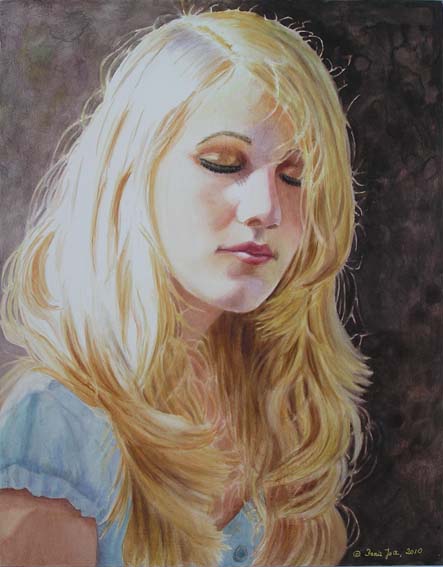
I have also painted on Aquabord by Ampersand, a rigid hardboard panel that does not need to be stretched. Its absorbent, textured surface behaves very differently from traditional watercolor paper, so it takes practice to understand how washes and layers respond.
The colors can look beautifully rich, and pigment can be lifted back almost to the white surface. This makes it wonderful for recovering highlights or making strong corrections. At the same time, it is easy to disturb an earlier wash when adding another layer.
A finished Aquabord painting can be protected according to the manufacturer’s current instructions and displayed without glass. Always test the complete finishing process first, because the painting cannot be changed easily after it has been sealed.
My handmade watercolor canvas
I also create my own watercolor canvas by stretching real watercolor paper over wooden stretcher bars. I assemble the bars, wet a sheet of 140 lb paper, pull it carefully around the frame and staple it on the back.
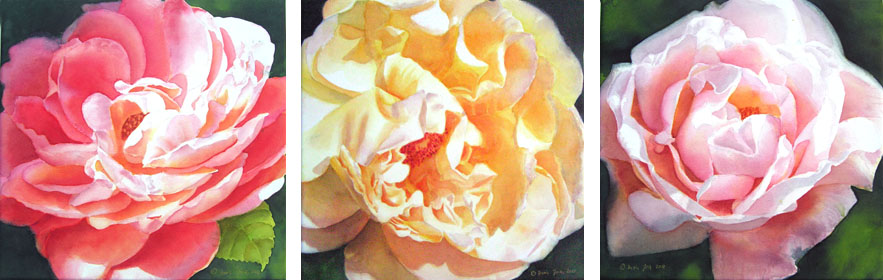
These three roses were painted on stretched 140 lb cold pressed Arches watercolor paper. I painted the edges as well, so the works could be displayed like traditional canvases.


The result looks much like a stretched canvas for oil or acrylic painting and can be framed without glass. I protect the completely finished painting with a suitable archival spray varnish, applied in careful layers. Always follow the current manufacturer’s instructions and test the varnish on a sample first.
See how I stretch watercolor paper over wooden bars →
A note about Reeves Watercolor Board
I have also painted on Reeves Watercolor Board. The board is pleasant to paint on, but it is quite thin and can begin to buckle. Wetting the back can sometimes help it become flat again, but for my own work it is not a surface I would choose first.
Which watercolor surface is best?
The best surface is the one that supports your own way of painting. Try more than one paper or board, observe what each allows you to do, and give yourself time to become familiar with it.

thank you for all this info it was exactly what i needed